Tiger's Eye

$19.89 USD
Size of Bead Stones - Custom Size of Bracelet

Steady Vitality

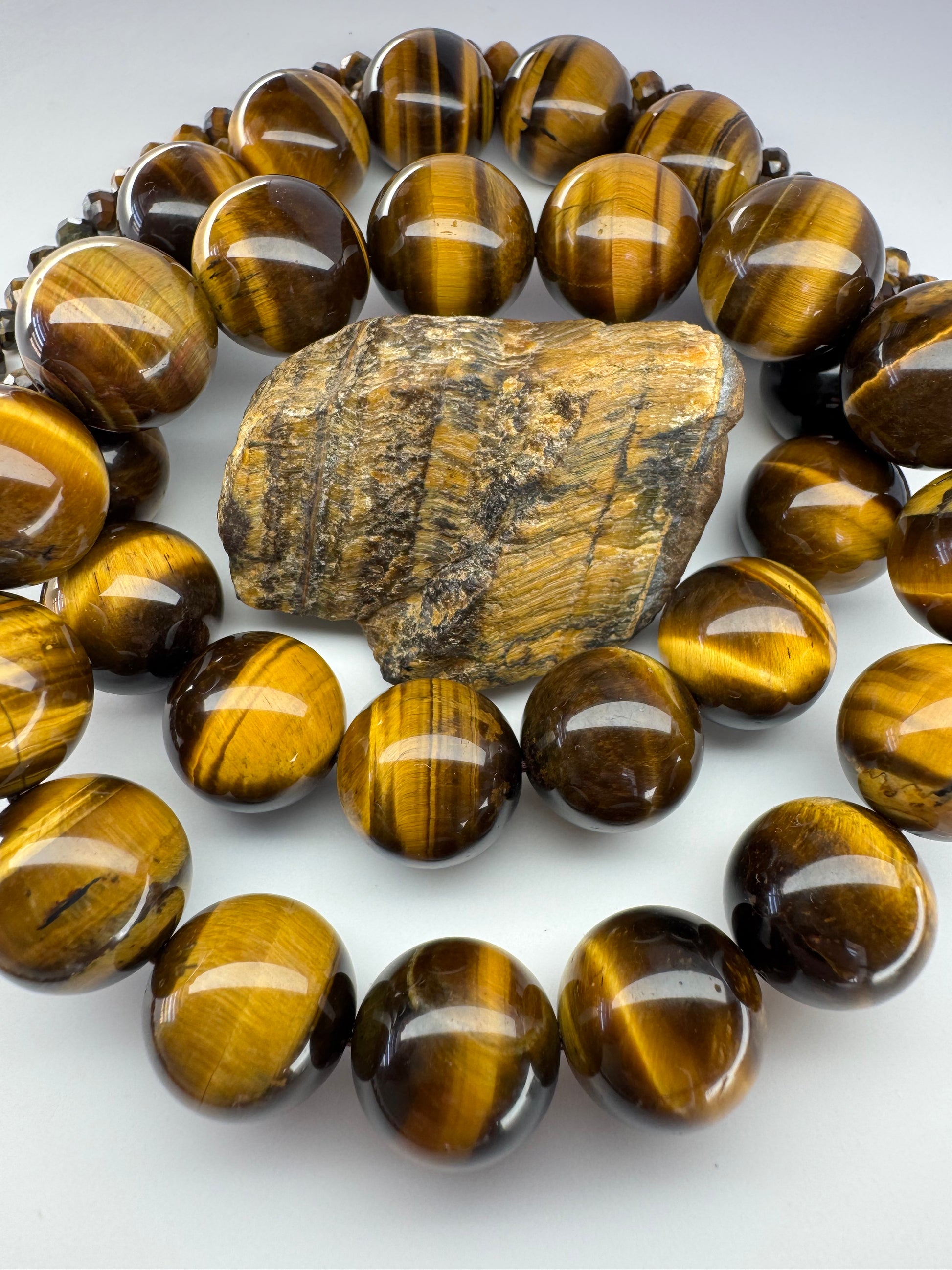
Tiger’s Eye is a stone built around movement, not because the stone itself changes, but because light seems to travel through it. Golden ribbons shift across chocolate brown, bronze, amber, and near-black quartz, creating the silky optical phenomenon known as chatoyancy.

Its beauty comes from an extraordinary meeting of silica, iron, fibrous mineral growth, tectonic movement, oxidation, and time. The result is a stone that visually appears to separate light from shadow, an image that has also become important within modern Chinese-medicine-inspired Stone Medicine interpretations of Tiger’s Eye.

Please note: 1( Sizing Info below; 2) Bead sizes and inclusion patterns vary naturally — no two stone beads or bracelets/necklaces are exactly alike; 3) Photos are taken in different lighting; colors may appear slightly different in person depending on natural light, indoor light, and your screen settings.

Origin & History

Tiger’s Eye is best known from the ancient iron-rich formations of South Africa’s Northern Cape, one of the world’s most important historical sources of the material. Documented mineralogical work places crocidolite and Tiger’s Eye from this region at least as far back as the late eighteenth and early nineteenth centuries. Mindat references historical research tracing the discovery and description of crocidolite and pseudocrocidolite in the Northern Cape from 1784 to 1811. 

The material eventually became something of a geological celebrity.

By the mid-1870s, Tiger’s Eye commanded unusually high prices in Europe because it was considered scarce. Rich South African deposits later entered the market, dramatically increasing supply. Contemporary historical reporting notes that by around 1900 it had gone from an expensive rarity to a much more accessible decorative gemstone. 

Today, important deposits are known from South Africa and Western Australia, with occurrences also documented in several other countries. GIA holds an extraordinary Tiger’s Eye specimen from the Marra Mamba Iron Formation of Western Australia, illustrating just how large and spectacular these fibrous quartz formations can become. 

You will frequently read that Roman soldiers carried Tiger’s Eye for courage and protection. This tradition is repeated widely in modern gemstone literature, but strong archaeological evidence specifically tying Tiger’s Eye to Roman military use is difficult to establish. Roman culture certainly made extensive use of gemstone amulets, but I prefer to present the Tiger’s Eye connection as later historical tradition rather than established archaeological fact.

That distinction matters.

Also Known As

Tiger Eye
Tiger’s Eye Quartz
Golden Tiger’s Eye
Pseudocrocidolite, an older mineralogical term
Tiger Eye Quartz
Golden Tiger Eye

Related but distinct materials include:

Hawk’s Eye / Blue Tiger’s Eye: material in which more of the blue crocidolite-related coloration remains. Mindat describes Blue Tiger’s Eye as silicified crocidolite in which the fibers have not undergone the same degree of alteration to iron-rich products. 

Red Tiger’s Eye: naturally reddish material can occur, although heating is also commonly used commercially to produce or intensify red coloration.

Tiger Iron: a different rock composed of bands including Tiger’s Eye, hematite, and red jasper.

Pietersite: related fibrous quartz/chalcedony material with a much more brecciated and chaotic structure rather than the organized parallel fibers of classic Tiger’s Eye. 

Mineral & Geological Notes

  • Mineral family: Quartz
  • Primary composition: Silicon dioxide, SiO₂
  • Crystal system: Trigonal
  • Mohs hardness: Approximately 7, consistent with quartz
  • Optical phenomenon: Chatoyancy
  • Major associated mineral components: Altered riebeckite/crocidolite fibers and iron oxide/hydroxide minerals including hematite and goethite.
  • Tiger’s Eye was historically described as a classic pseudomorph, meaning quartz was believed to have replaced crocidolite while preserving its fibrous structure.
  • Modern microscopic research has complicated that explanation.
  • Evidence now supports an episodic crack-seal process in which tectonic fractures repeatedly opened and were filled as quartz and fibrous riebeckite grew together. Subsequent oxidation altered iron-bearing fibers into iron oxides and hydroxides. 
  • Those aligned fibers are essential to the stone’s appearance. When light strikes the parallel structure, it creates the silky band that seems to glide across the surface as the stone moves. GIA describes this as the characteristic chatoyancy of Tiger’s Eye. 

Stone Character & Appearance

The Tiger’s Eye used here shows an especially beautiful range.

Looking across these stone beads, you can see warm honey, caramel, antique gold, bronze, chestnut, deep chocolate, charcoal brown, and occasional reddish-brown areas. Some stone beads display broad golden flashes, while others have narrower fibers that create a more concentrated streak of light.

Several stone beads also contain darker zones and complex fibrous markings rather than perfectly uniform bands.

This variation is desirable.

The moving golden line is not a coating or surface effect. It comes from the orientation of the internal fibrous structure itself. The different widths, directions, colors, and intensities of those bands give natural Tiger’s Eye its character.

Strong chatoyancy is particularly prized because cutting and polishing must be oriented correctly relative to the fibers for the optical effect to appear at its best. Gem-A notes that Tiger’s Eye displays its characteristic silky appearance because of parallel fibrous structures within the quartz. 

Stone Support & Traditional Perspectives

Traditional & Historical Use

Tiger’s Eye’s modern reputation centers around courage, alertness, protection, confidence, and discernment.

Claims of very specific ancient medicinal uses should be treated cautiously. Unlike jade, cinnabar, pearl, amber, or certain other minerals with extensive documentation in historical East Asian materia medica, Tiger’s Eye does not have a strong record as a classical Chinese medicinal substance.

Its most detailed health-related correspondences belong instead to modern Stone Medicine systems informed by Chinese medical theory.

That makes the distinction especially important:

Classical TCM: Tiger’s Eye is not a standard classical herbal or mineral prescription.

Modern Chinese-medicine-inspired Stone Medicine: Tiger’s Eye does have specific energetic and organ-system correspondences.

Eastern Perspective, TCM-Inspired

This is where Tiger’s Eye becomes much more interesting than the usual “confidence stone” description.

In Chinese medical theory, yellow, ochre, and earthy tones are often associated with the Earth element, whose primary organ pair is the Spleen and Stomach.

Within TCM, these organs represent far more than anatomical structures. The Spleen/Stomach system describes the body’s energetic process of receiving nourishment, transforming it, transporting it, and converting it into usable Qi and Blood.

In modern Stone Medicine, Tiger’s Eye is connected particularly strongly with this idea of transformation.

Spleen Qi and nourishment

In Stone Medicine: A Chinese Medical Guide to Healing with Gems and Minerals, Tiger Eye is specifically referenced in connection with hypothyroid patterns, particularly where the therapeutic intention is described as strengthening Spleen Qi compromised by Heat. 

This does not mean Tiger’s Eye has been shown to treat hypothyroidism.

Rather, within that Stone Medicine system, the thyroid condition is interpreted through a Chinese energetic pattern involving depleted transformation and nourishment.

That makes the traditional functional theme of Tiger’s Eye much more specific than simply “energy.”

It is about turning what you receive into something the body can use.

Clear versus turbid

Some contemporary Daoist Stone Medicine teachers describe Tiger’s Eye symbolically as helping the body energetically distinguish the clear from the turbid, an idea related to proper Spleen transformation within Chinese medical theory. 

In practical energetic terms, that makes Tiger’s Eye particularly relevant to traditions involving:

digestive weakness,
fatigue associated with depletion,
poor energetic transformation,
mental heaviness accompanying physical exhaustion,
difficulty sustaining effort,
and rebuilding after long periods of overextension.

Again, these are traditional energetic associations, not demonstrated physiological effects of wearing the stone beads.

Warming or cooling?

Tiger’s Eye is generally interpreted in modern Stone Medicine as more warming, strengthening, mobilizing, and nourishing than cooling or sedating.

That distinction is important.

This would not be the first stone I would choose when someone is looking primarily for deep sedation or sleep support. Lepidolite, Amethyst, or certain other stones occupy that role more naturally.

Tiger’s Eye is better suited symbolically to the person who feels depleted, scattered, hesitant, or unable to convert intention into sustained action.

Ayurvedic Perspective

I could not find reliable evidence that Tiger’s Eye has a significant role in classical Ayurvedic gemstone medicine.

Modern crystal-Ayurvedic practices commonly associate its gold and brown coloring with the Manipura or Solar Plexus chakra, connecting it with will, digestive fire, motivation, and self-direction.

Those associations should be understood as modern integrative interpretations, not ancient Ayurvedic prescriptions.

Other Cultural Perspectives

Many online sources attribute Tiger’s Eye to ancient Egypt, Rome, India, and numerous other civilizations.

The evidence is uneven.

Rather than repeat each modern claim as ancient history, Moe Gems distinguishes documented mineral history from later spiritual traditions.

Tiger’s Eye unquestionably became a widely loved ornamental material because its moving band of light resembles an animal’s eye. The themes of vigilance, perception, courage, and watchfulness are therefore understandable symbolic interpretations, even when specific ancient stories cannot be independently verified.

Mineral Composition Insight

Tiger’s Eye is fascinating because its symbolic story is remarkably compatible with its geology.

Silica

  • The stone is predominantly quartz, SiO₂.
  • Silica is fundamental to enormous portions of Earth’s crust and gives quartz its durability and structural stability. In modern energetic traditions, quartz has therefore often become symbolically associated with structure, organization, coherence, and amplification.

This is symbolism, not mineral supplementation. -- Wearing Tiger’s Eye does not deliver silica to connective tissue, skin, hair, bones, or any other organ.

Iron

  • The gold, brown, and rust colors owe much of their appearance to iron-bearing minerals and the oxidation of the original amphibole components.
  • Iron has obvious physiological importance in human blood and oxygen transport, which is one reason iron-rich stones have acquired symbolic associations with vitality, stamina, warmth, blood, and physical strength across modern energetic traditions.

But an important distinction applies:  The iron inside Tiger’s Eye is mineral-bound and is not absorbed into the body simply because the stone touches your skin.  Its relevance here is mineralogical and symbolic.

Fibrous architecture

  • The internal fibers may be the most meaningful feature of all.
  • Tiger’s Eye does not produce its optical effect because of color alone. The fibers must remain organized and directional.
  • Light becomes visible because structure exists.
  • That geological fact makes Tiger’s Eye a particularly compelling stone for themes of:

clarity, discernment, organization, direction, and turning diffuse effort into focused movement.

Functional Focus

Spleen and Stomach Energetic System

Within modern Chinese-medicine-inspired Stone Medicine, Tiger’s Eye is most appropriately placed within the Earth element and Spleen/Stomach functional system.

Primary energetic themes include:

  • Transformation of nourishment
    Sustained Qi
    Digestive vitality
    Energy utilization
    Physical and mental stamina
    Recovery from depletion

Secondary traditional themes include:

  • Thyroid-related energetic patterns
    Decision-making
    Focus
    Motivation
    Confidence
    Adaptability under pressure

Support Themes

The following support themes are based on traditional use, Stone Medicine, mineral composition, and modern energetic interpretations. They are not claims of medical effectiveness.

Digestive Depletion

Within Chinese medicine, the Spleen is responsible for the energetic process often translated as transformation and transportation.

When Spleen Qi is described as weak, traditional signs may include fatigue, heaviness, sluggish digestion, lack of appetite, loose stools, mental fog, and difficulty sustaining energy.

Because Tiger’s Eye is associated in modern Stone Medicine with strengthening and nourishing Spleen Qi, it may be chosen energetically during periods when a person feels poorly fueled despite eating or resting.

Fatigue and Burnout

This is one of the more natural modern applications for Tiger’s Eye.

Its symbolism is not “push harder.”

It is closer to rebuilding enough internal support to move steadily again.

Someone recovering from prolonged stress, overwork, or depleted routines may therefore pair Tiger’s Eye with stones traditionally associated with rest and recovery rather than using stimulating stones alone.

Thyroid Support

This deserves special attention because there is a direct Stone Medicine reference.

Stone Medicine associates Tiger Eye with hypothyroid conditions interpreted through weakened Spleen Qi after Heat. 

From a Moe Gems perspective, we describe this as:

Traditional energetic thyroid support, particularly when fatigue, digestive weakness, or depleted Earth-element energy accompanies the pattern.

It should never be presented as treatment for hypothyroidism, Hashimoto’s disease, or any thyroid disorder.

Metabolism and Weight

Because the TCM Spleen/Stomach system concerns energetic transformation of food and fluids, Tiger’s Eye sometimes becomes associated in modern stone practice with metabolism.

Support for energetic digestive function, nourishment, and consistent routines. 

Blood and Vitality

Iron-rich coloration contributes to Tiger’s Eye’s long-standing symbolic connection with stamina and vitality.

For concerns involving actual anemia, iron deficiency, circulation disorders, or chronic fatigue, laboratory testing and medical evaluation matter.

Energetically, however, Tiger’s Eye can be used as a symbolic companion for rebuilding strength and maintaining sustainable energy.

Mental Fatigue and Decision Overload

The moving but organized bands of Tiger’s Eye have long inspired associations with discernment and clear perception.

It may be especially appropriate during periods of:  decision fatigue, career transition, high responsibility, financial planning, long-term projects, or rebuilding after burnout.

This is one reason Moe Gems prefers "Steady Vitality" over describing Tiger’s Eye simply as a protection stone.

Its strongest Stone Medicine story is Spleen Qi, nourishment, transformation, fatigue, vitality, and certain thyroid-related energetic patterns.

Purposeful Pairings

Thyroid and Energetic Depletion

Tiger’s Eye + Nephrite Jade + Aquamarine

  • In Stone Medicine, Tiger Eye is referenced for a hypothyroid pattern involving weakened Spleen Qi, while Aquamarine is mentioned in a different thyroid-related context involving hypoadrenal patterns, with Nephrite Jade added to strengthen that combination. 
  • This makes the three an interesting traditional Stone Medicine-inspired pairing, although none replaces thyroid testing or medical treatment.

Digestive Weakness and Fatigue

Tiger’s Eye + Carnelian + Yellow Jasper

Tiger’s Eye contributes the Spleen/Stomach and transformation theme. Carnelian adds traditional warmth and vitality, while Yellow Jasper reinforces Earth-element symbolism.

Burnout and Rebuilding

Tiger’s Eye + Lepidolite + Smoky Quartz

  • Tiger’s Eye brings steady forward energy.
  • Lepidolite introduces a more restful nervous-system theme.
  • Smoky Quartz contributes containment and grounding.
  • Together, they make more sense for burnout than stacking several stimulating stones.

Focus During Demanding Work

Tiger’s Eye + Fluorite + Clear Quartz

  • Tiger’s Eye emphasizes sustained action.
  • Fluorite is commonly chosen for organization and mental sorting.
  • Clear Quartz provides the traditional amplification component.

When Strength Feels Low

Tiger’s Eye + Carnelian + Red Jasper

  • A warmer combination traditionally centered on stamina, drive, blood symbolism, and physical engagement.
  • This is best viewed as an energetic vitality pairing, not treatment for anemia or chronic fatigue.

Western Perspective

Western crystal traditions most often associate Tiger’s Eye with confidence, courage, discernment, willpower, protection, and practical decision-making.

For Moe Gems, its most useful Western interpretation is less about fearlessness and more about seeing clearly enough to act deliberately.

A simple pairing would be:

Tiger’s Eye + Smoky Quartz

  • Tiger’s Eye for direction and follow-through.
  • Smoky Quartz for steadiness and containment.

Cleansing & Charging

  • Moonlight
  • Sound
  • Smoke
  • Satin Spar (often sold as Selenite)

Tiger’s Eye is generally safe around water for brief cleaning because it is a stable quartz variety. Use mild soap and water when necessary, then dry thoroughly.

Prolonged direct sunlight may gradually dull the richness of the golden colors over many years, so extended UV exposure is best avoided.

Care Notes

Avoid harsh chemicals and ultrasonic cleaners.

Transparency

At Moe Gems, transparency is one of our core values.

This bracelet is made using 100% natural Tiger’s Eye. Natural variations in color, chatoyancy, and fibrous patterning are expected and celebrated as evidence of genuine formation. Unless specifically stated otherwise, Moe Gems does not source dyed or synthetic Tiger’s Eye.

Disclaimer:  The information provided is for educational and energetic support only and is not intended to diagnose, treat, or prevent any medical condition. I am not a licensed medical professional. The details shared are based on traditional and energetic uses of gemstones in TCM, Ayurveda, and Western metaphysical practices. Please consult a healthcare provider for health related concerns, and always feel free to do your own research to find what resonates for you personally.

Choosing & Understanding Bracelet Sizing

Made-to-Order Bracelets (Custom Sizing):

 Follow these simple steps:

  1. Visit our Sizing Guide to learn how to accurately measure to get the right fit for you.
  2. Return to the product page, choose your bead size, and select the “Custom - Bracelet Size” option.
  3. At checkout, enter the bracelet measurement you prefer in the “Special Instructions” box.

📲 Follow Moe Gems on social media for videos on stone bead sizes, fit tips, and more!

Please note: Stone bead sizes and inclusion patterns vary naturally—no two bracelets or beads are exactly alike.

Most Photos are taken in natural light or studio light and with an Iphone -  the goal is to showcase the natural beauty of the stones, colors of the stone may vary slightly depending on your screen settings.

Made with care

Heirloom quality

Premium

Nature’s Gifts

Styled With
Tiger's Eye
Materials

100% natural gemstones—never dyed, never faked. If anything is enhanced or man-made, we’ll tell you. Transparency always.

Care

Treat your pieces with gentle care—your gemstones are strong, but cords and metals deserve kindness. Take off before swimming, showering, or rough adventures.

Details

Each piece is one-of-a-kind, handcrafted or selected with intention that makes it uniquely yours.

You may also like